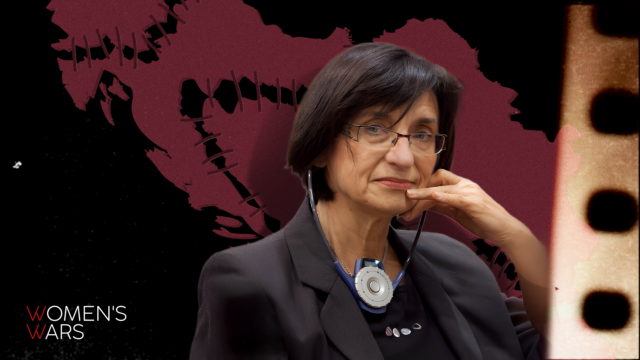
BIRN’s series about women’s wartime activism tells the story of Katarina Kruhonja, who quit working as a neurologist to become a full-time activist and advocate for reconciliation in conflict-ravaged eastern Croatia.
This post is also available in this language:
Shqip Bos/Hrv/Srp
In 1997, Katarina Kruhonja quit her job as head of the neurological diagnostic department in Osijek, eastern Croatia, to become a full-time activist.
“The war and the experience of violence in front of my eyes … it changed my life,” Kruhonja says.
During the 1991-95 war for Croatian independence, she was working as a doctor, but also as a peace activist. “We established the Centre for Peace, Non-Violence and Human Rights in Osijek, in the middle of a city that was then under attack by Serbian forces,” she recalls.
Some people in the city considered campaigning for peace in such a situation “very strange, inappropriate”, but Kruhonja persevered. Eventually, however, the situation became increasingly fraught; she often felt that she was “missing or failing in my basic job as a medical doctor, because my thoughts were always on peace work”.
She says she realised that “there were quite a lot of good doctors – but there were not a lot of people willing to work on peace in the middle of a war, or in a post-war situation”.
So she resigned from her job as a doctor and dedicated herself to full-time peace and human rights campaigning – a cause she has championed ever since.
The trigger for her resignation came when eastern Croatia, which had been under rebel Serb control, during the war, was reintegrated into the rest of the country under the auspices of the UN’s Transitional Administration in Eastern Slavonia, Baranja and Western Sirmium (UNTAES) peacekeeping mission, which ran the area from January 1996 to January 1998.
“And what we had been doing all those three, four years [during the war], was to prepare ourselves and people for this [reintegration],” she explains. “That was the reason why I then said: ‘Now I don’t have another choice. I have to give what I can to contribute to this process that is taking place.’”
Her efforts drew international recognition: the year after she quit her job, in 1998, Kruhonja won the annual Right Livelihood Award, which honours individuals committed to advancing social justice and environmental causes.
Women activists had some advantages
Katarina Kruhonja (seated on the left) with some of her students as post-war reconciliation classes in Ilok, Croatia, October 1988. Photo: EPA/Josip Petric
Most of the activists Kruhonja worked with were women. “More and more people joined us, and most were women – 90 per cent,” she says. Being an activist during the war in Croatia wasn’t easy, but being a woman sometimes helped.
“In the field, being a woman sometimes was an advantage because normally we could go without arms near armed people or soldiers. Sometimes it was not so dangerous to say that we were working for peace and for peaceful reintegration in Croatia, because the soldiers and warlords didn’t recognise us as a real danger,” she says.
She explains how women activists could often move around more easily exactly because of the low estimation of their work by those bearing arms. On the other hand, however, this was “also a disadvantage, because they didn’t take you seriously”.
Training women as ambassadors of peace
Katarina Kruhonja (right) with other winners of the 1998 Right Livelihood ‘alternative Nobels’ award after the ceremony in Stockholm, December 1998. Photo: EPA/Pressens Bild/Jan Collsioo
In March 1996, Kruhonja helped found the Coordination of Peace Organisations of East Slavonia, Baranja and West Sirmium, a collaboration between three organisations from Serbia and eight from Croatia. The initiative worked to reintegrate Serbs in eastern Croatia and establishing the confidence to prevent them from leaving the country in large numbers when the UN mission and its perceived protection ended.
Together with the other organisations, Kruhonja worked on reconciliation and rebuilding trust between Croats and Serbs. She highlights one occasion when she was working “with a group of women displaced from an area under the control of Serbs, mostly Croats, and another group of women inside the area under UN and Serbian control, who were mostly Serbian women.
“We worked with the Croatian women and our goal was to prepare them to go back to their villages in a peaceful way and how to face the situation on the spot when they arrived and how they could be an ambassador of peace there,” Kruhonja explains. The goal in the work with the Serb women was similar.
When the women were asked what would help them to reintegrate and live in peace, their answers revealed the level of trauma they had endured.
“The Croatians said: ‘We can’t imagine even listening to the Serbian language’, because during the war there had been complete segregation. You did not even hear Serbian speech. And if you heard it, it was immediately connected with aggression, suffering, and war crimes,” Kruhonja recalls.
So they asked each of the Croatian women to “read a text from one book in Cyrillic [alphabet] and in the Serbian language.
“Their instinct was to vomit. That was really the level of psycho-organic distress – how they felt at that time.”
Meanwhile, the Serb women “said they hadn’t had an opportunity to even talk to each other because the Serbian paramilitary forces kept them in fear in their houses, not meeting each other. They were afraid to even talk.”
The women had to relearn how to talk to each other without fear. “We trained them, we exercised with them – about just speaking,” she says, emphasising how difficult the reintegration process was in the post-war period.
Reconciliation has a long way to go
Yugoslav People’s Army soldiers on the front-line facing Osijek, Croatia, November 1991. Photo: EPA/Mike Persson
Despite working on peacebuilding for over three decades, “there is still a lot of work to be done”, Kruhonja warns.
“Unfortunately, in Croatia, and I would say not just in Croatia, but [across the region], the dominant narratives still remain ethnocentric and are very tied to the ethno-nationalistic agendas of the political elites,” she says.
While the growth of civic initiatives across the former Yugoslav countries is promising, Kruhonja believes they are “not connected [with each other] enough and there is no strategic cooperation”. Their financial stability is also unsecured.
She also notes the persistent problem of historical revisionism and the glorification of Croatia’s military victory, which can alienate the Serb minority. “We in Croatia still are [involved] in the mythologisation of the Homeland War – and that is not good for inclusive memories and inclusive history,” she concludes.
About The Author