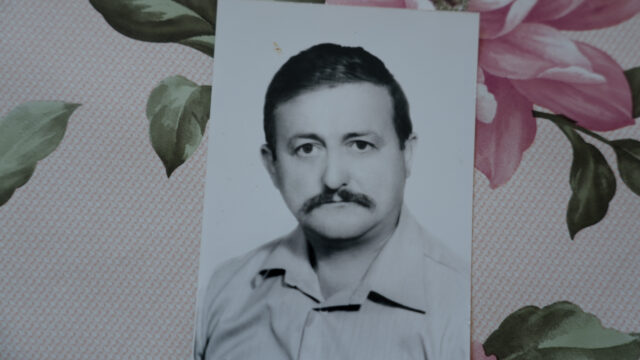
The morning before the identification, Donji Petrovici is cloaked in fog. Saponja says she couldn’t sleep.
“I feel I’m going to faint,” she says as she prepares for the identification in Banja Luka, some 150 kilometres away.
On the road to Banja Luka, she explains that after the identification, she will call family and friends to inform them about the funeral. She thinks they will come from all parts of the country and beyond. She’s mostly quiet the whole way.
“It’s fine. It’s a little better than when I got up this morning. I brought some lemonade, but I won’t need it. I’m brave,” she says quietly, as her husband, Goran, drives..
In the neighbourhood of Banja Luka near the Institute of Forensic Medicine, where the identification is scheduled to take place, Dragomir Bursac’s daughter, Vera Zivkovic, who is also going to the identification, meets up with the rest of the family.
Bozidar Knezevic, from the Institute for Missing Persons of Bosnia and Herzegovina, is also with the family for the identification. Bursac’s remains are being kept on the floor below the Institute. The family will not see them. They say they don’t have the strength. Saponja and Vera Zivkovic think it is better that way, so it wouldn’t be the last picture they have of their loved one.
While Saponja and Zivkovic wait for the representative of the State Prosecutor’s Office to conduct the official procedure, police officers take personal information from the family and those present at the identification.
Although BIRN had obtained permission from the state prosecution, which manages identifications, to observe the process, in the end this was not permitted.
After the identification was completed, at Zivkovic’s house, she explained what happened. During the identification, they were told that they found the remains of Bursac and other people in a pit in Livno that had been mined. Rocks had collapsed on the bones.
Zivkovic said his skull had been buried with the remains of another person, and more DNA work had to be done to put all of his remains together. It still remains unclear how he ended up in Livno during the Bosnian war.
“They said we could collect him and arrange a funeral. We signed those papers, we agreed,” Saponja said.
“They asked if we wanted to see pictures. The doctor said it was disturbing and that he wouldn’t suggest it. We couldn’t. They even asked us to look at the skeleton if we wanted to – we couldn’t do that either,” she added.
After the identification at the Institute of Forensic Medicine, Saponja said that everything has become easier for her.
“When I went in, I had the feeling that I was going to collapse. It’s easier for me now. Now we know that we will bury him, that this will end,” she explained.
Three days after the identification, Dragomir Bursac was buried in the village of Bursaci. Family and friends from countries around former Yugoslavia came to the funeral.
After more than 30 years – unlike those who are still searching for their loved ones – his family, at least, now has a place to go and light a candle in his memory.
About The Author