President re-elected in landslide
Croatian President Zoran Milanovic on election night in January 2025. Photo: EPA/ANTONIO BAT
Croatia began 2025 with a continuation of its presidential elections. In the second round on January 12, voters chose the incumbent president Zoran Milanovic over Dragan Primorac, the candidate supported by the ruling Croatian Democratic Union, HDZ. Milanovic won convincingly, securing 74.68 per cent of the vote – the best result achieved by any presidential candidate in Croatian history.
Price rise protests
For few days in February, shops were empty in Croatia. Photo: V.Tesija/BIRN
In February 2025, the consumer activism platform Hello, Inspector instigated a general boycott of stores and petrol stations as part of a larger wave of consumer protests against rising prices. The scale and persistence of these boycotts highlighted strong public discontent with economic conditions, especially inflation and retail pricing. The boycotts had some effect, as the government decided to ‘freeze’ the prices of some goods, but that did not affect the rising inflation.
HDZ sweeps local polls
Independent candidate Iva Rincic was elected mayor of Rijeka in May. Photo: I.Rincic/Facebook
In the local elections on May 18, the ruling Croatian Democratic Union, HDZ achieved a decisive victory, winning in most cities, counties and municipalities. However, the triumph was overshadowed by the partys continued inability to gain power in the capital, Zagreb, where Tomislav Tomasevic of the Mozemo! (We Can!) movement remained mayor. The biggest surprise occurred in the port city of Rijeka, where the Social Democratic Party mayor, after a decade in power, lost to independent candidate Iva Rincic (pictured).
Battery-powered train departs
The battery train, a product of the Croatian company Koncar. Photo: koncar.hr/Ratko Mavar
The first battery-powered electric train in Croatia was put into test service in May on the Zagreb-Bjelovar route. It was especially significant because the train was manufactured by a Croatian company, KONCAR Electric Vehicles. The train entered regular daily service in September.
Nationalist mega-concert
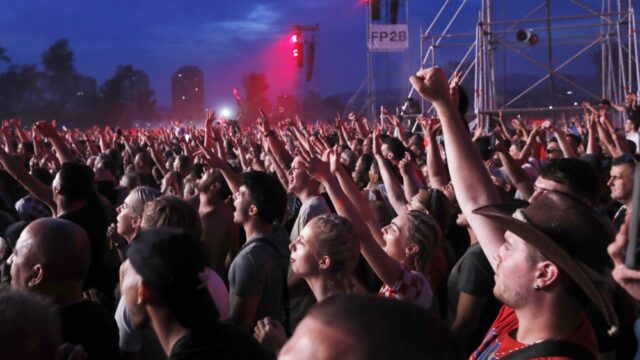
Croatian singer Marko Perkovic Thompson on stage at the Hippodrome venue in Zagreb, July 2025. Photo: EPA/ANTONIO BAT
Marko Perkovic Thompson, a singer known for his strong nationalist themes, held a major concert at the Zagreb Hippodrome on July 5, 2025. The event was reported to have set a world record, with over 300,000 tickets sold. It also had significant political repercussions, boosting far-right nationalist sentiment and increasing inter-ethnic tensions that would affect society for months afterwards.
Military conscription reintroduced
Croatian soldiers after taking their ceremonial oath. Photo: MORH
On October 24, 2025, Parliament passed amendments to the Defence Act that brought back compulsory military service after 17 years. Under the new law, men born from 2007 onwards will be required to undergo basic training, with around 4,000 recruits per year. The move was justified by rising security concerns and a desire to strengthen national defence.
LNG capacity grows
LNG terminal near Omisalj. Photo: lng.hr
In November, testing of the operations of the Liquefied Natural Gas terminal in the port of Omisalj on the Adriatic Sea was completed. The terminals maximum capacity was increased from 3.9 billion cubic metres of natural gas to 6.1 billion cubic meters. This expansion has made Croatia an important energy hub for Central Europe and has provided an alternative gas supply route, an especially significant development following the European embargo on Russian gas imports.
Anti-fascists march
Anti-fascist marchers with a banner bearing the slogan “United Against Fascism”. Photo: Sandro Lendler
Amid increased tensions caused by the rise of the far right in Croatia, the United Against Fascism initiative organized protest marches in Zagreb, Rijeka, Zadar and Pula in November.We do not accept that the mere existence of national minorities is treated as a provocation, nor do we accept a vision of patriotism that draws its symbols from the darkest episodes of our history, the march’s organisers said. Attacks on protesters by individuals dressed in black and wearing balaclavas were recorded in both Zadar and Rijeka.
About The Author